Between Work and Word Art
20 Nov 2025
When
20th of November 2025Who
Nastya Livadnova, Anton SpielmannCategory
ArtShare


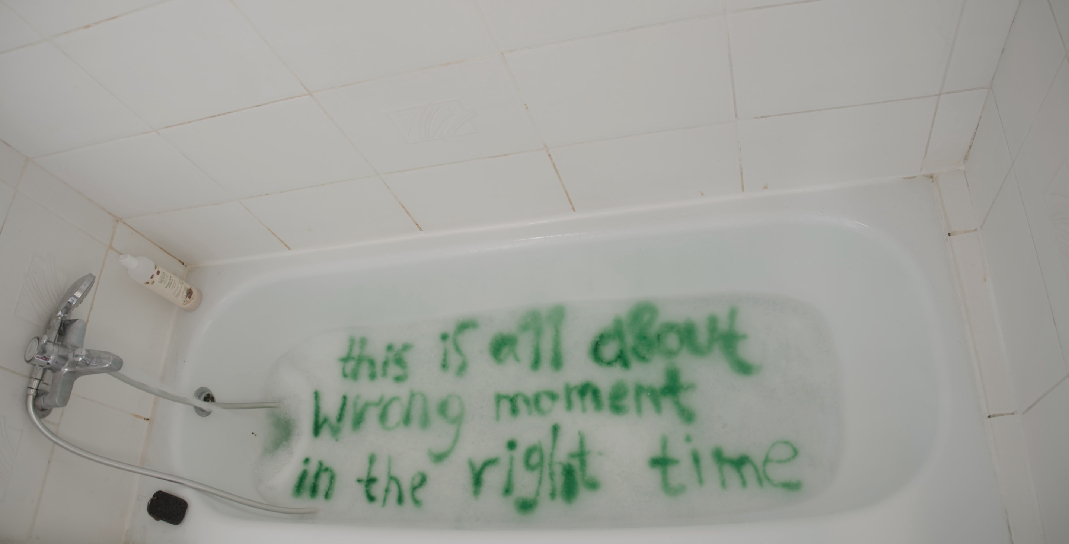
A conversation between Nastya Livadnova and Anton Spielmann, on the occasion of the exhibition This Is All about Wrong Moment in the Right Time, held between 20 November and 20 December 2025 at Chiquita Room.
Anton: HEYY
Nastya: heeeeeeeey
Anton: In the morning I was thinking about something I wanted to ask, but I forgot about it.
Nastya: The question: if you forget — does it even matter?
Anton: [laughs] I thought, mh, this could be a good question. Like a journalist preparing for a talk or something. Ahahah! Or a curator thinking about an artwork. Since when do people say artwork?
Nastya: I hate this word! Do you use it?
Anton: I use it too, but not really.
Nastya: How do you see this word — artwork?
Anton: I just do. It’s common. But every time i think about the combination of Art and Work. It’s a bit strange to me. I like Art Word more than Art Work. And I feel that people nowadays say content more and more, not artwork, because the “art market” moved to the internet… to Instagram and so on. So artists today produce content.
Nastya: We live in the era when your personal troubles are new art problems.
Anton: For example — an Instagram post is comparable to a gallery opening.
Nastya: Nice shot. True.
Anton: Before the word Work entered the art world… I think it was Werk. Like piece. Art piece. Then everything became work. So capitalism won anyway. ahahah
Nastya: I don’t get how society moved to the word content. It’s a neologism. What does content actually mean? What’s the difference between work and content? If work is slavery, content is what we keep doing again and again — to content — doing again and again.
Nastya: In Russian, the word “work” sounds like rabota, and its root rab means slave in English. And I feel it’s the same. Slavery didn’t go away — it just exists in a new form. We are modern slaves. Slaves of god’s mind.
Anton: What you describe with your slave reference could be a drastic translation of what I see as seekers, or prayers — a new kind of addiction. Liking stuff becomes a ritual. And people love rituals. But I would never call it slavery — because that term historically means something much darker, about having no choice. And this online capitalism slaves they fucking have a choice just stop it. But we can’t. It’s to late.
Anton: Do you see yourself as an object?
Nastya: Very cool question. What does an object do? Exist? Can it generate? And also — do you see yourself as an object?
Anton: No, I don’t see myself as an object. But I see that artists are becoming more and more like their pieces — their objects. Like self-representatives of an unknown digital god wish is themself. And their prayers — the audience — us — as likers of a work. So even artworks without any idea of transmediality or interactivity become interactive in a way. I question myself and ask you: Should we always like the artwork? Is „lliking“ art important for art? And I also would like to know: What is freedom for you? Is a woman in high heels free?
Nastya: I’ll write you later today.
Anton: Ok. I guess this is freedom.
Nastya: I see freedom as a space of different choices, and having the power not to depend on the comfort zone. I asked myself — was money invented to help people to be free? But from my experience, it works the opposite way. The more you have = the more you have to play non-stop. Your ego eats all these everyday facilities, and the more it eats, the less it can be without them. So tricky, as always.
Nastya: I’ve been very low these days, in my mind. Yesterday I opened the internet again and was thinking about what <cool people in the internet> do in real life — If they’re not inventing with their brain original images, they just look fascinating and fashionable— but being fascinating doesn’t mean being original, whats being <the coolest> in my vision. And I asked myself: Is being cool equal to being a modern object? Like you turn yourself into a genre — where people look at you all the time, non-stop — and you must keep one strict energy from you all the time to maintain their <approval> of being cool. And also — what does a cool person do? [pause] Thoughts?
Anton: It depends on how you describe “cool.” If you mean the mainstream kind — what most people consider cool — then to me, it’s often strange, and honestly, a bit boring. Every culture, every scene has its own ideology, its own rules for what “cool” means. In pop culture, it means something different than in art. A French smart-ass named Pierre Bourdieu called this habitus. He studied how we, as humans, carry our cultural and social links into what we perceive as I like this or I don’t. That’s what shapes our sense of cool. Pop culture…
Nastya: I see pop as a very hard genre to be truly cool in. In pop you need a true, innovative vision to be the cool one. Why do you see mainstream cool as not “awarded” cool? And also — what do you see as cool?
Anton: Yes. Pop art is hard because it’s brutal — like economics. It’s harder to make something in and out of it because there aren’t many places to fill.
Nastya: Because pop is the only genre where the “порог вхождения” — the threshold of entry — is low. But that’s tricky. The lower the threshold, the more people are trying something. [laughs]
Anton: The art world functions through limitation — and pop, in a way, too. There aren’t twenty Taylor Swifts at number one — there’s just her. But in reality, there are many Taylor Swifts — talent-wise, skill-wise. It’s not that she’s the only one on the planet; she simply made it as the one. Lucky her. (laughs) The stars happened to align just right for her life. And yeah she is also talented no doubt. Ahahha
Nastya: What do cool people do? And what are cool people — from your perspective, and socially?
Anton: Cool people don’t do anything specific i would say. Habitus — or coolness — isn’t something you can learn. (That’s what the French guy says.) It’s something we absorb without knowing — a social space we can hardly ever unlearn or imitate. It comes from childhood, from family, from class and culture. From what we learned. Being cool can mean that — in the right moment in time — ordinary people suddenly see you as extraordinary. Not for what you do, but for what you are. It’s not something you can study like guitar or math. It has to come naturally. And if you’re that lucky cool person — then you just are. That’s the whole trick.
Nastya: But people are trying to be cool. How can they even try?
Anton: Are you sure? Or is that maybe your imagination? Because truly cool people — whatever that even means — aren’t trying. They just are. The ones who try — they’re not that cool. I think people recognize what’s fake. They are not dumb Some are so obsessed with being cool that they forget to be. Not even themselves — just something else. And that, I’d say, is being without character, whether cool or not. That’s what I love about art — not the industry, but art itself. artists i like don’t care about being cool. They see, they feel, they understand — without counting clicks and likes. Is that what’s cool now? Likes on Instagram? It’s a new mechanism — we see the likes first, and then we decide if we feel something. The algorithm triggers the emotion. Capitalism is a very old man… and this bitch just doesn’t want to die.
Nastya: You know, a few days ago I read a very funny quote: “Before stylists, there was style.” And I find it so true. Stylists help articulate what is cool, what matches your energy — but it’s like a pill.
You can’t live on medicine all the time — your brain stops working intensively on its own. In the past years, so many stylists were born in Moscow — really. The stylist culture is gaining an audience like crazy. People who come to stylists want to be socially cool, what we call being <approved by 20 abstract people from industry> And they do it through the essential attribute of that — fashion. Also, stylists do a very good job. But when I see their clients — someone who has a stylist and looks like a “fashion chick” — I always wonder what their r core is. Because it looks fancy, but it’s not her at all. It’s all fake.
All this “trying to be cool” is fake as hell. There is no coolness if you can’t do it on your own. If you can’t find what matches you the best from what surrounds you –– that is a lack of sensitivity which essentially leads to the lack of originality. By the way, i love stylists. I am a big fan of the profession. They are new modern form of art itself. They sell their domination to the people who wants to dominate. It is amazing.
Anton: I feel you partly on what you describe.
Nastya: The question is — if everyone understands what fake coolness is, why do people even try to look cool?
Anton: Maybe Werner Herzog would say now: “Because they want to overcome the failure of being nobody — a tiny, miserable self.” Ahaha. People try on so many things in there lives. They dream. Most people idealist there whole life without knowing it’s illusion. People open shops — and close them when the idea doesn’t work. But People love, do art. And this artsy candyshop has no opening hours. They beleave in this shit 24h and maybe forever. That’s what makes us move. And dream. If we don’t dream, we die. That’s actually a scientific truth. I read somewhere. And this dreaming state can bring people in very strange live decisions.
Nastya: What’s a cool person to you?
Anton: To me, a cool person is someone who finds a way to tell the most honest story about themselves — and at the same time, about everyone else. Something deeply personal, yet somehow universal. For example — you are cool to me. Your work connects back to who you are as a person, and at the same time, it opens up to the whole world. I don’t really care where you live, what your gender is, or what your habitus might be. When I watch your videos — any of your work — I don’t see those categories anymore. And that, to me, is what’s truly cool. Art is cool. I like it.
Nastya: Very true.
Anton: Art is something else — like a bigger understanding of the thing while everything gets flat, boring and equal. It tells me also about myself. I can breathe in it. It’s like air — and on the other hand, I stop breathing. And if I feel this — I feel art. If I understand — or should understand — the language, the culture, the person, the… lalalalalala… whatever.
Nastya: At the same time, we are extremely different, and I always think — what do you find in our conversations, with all that going on in your life? Like, I’m really wondering why it connects to you. My favorite and at the same time least question: why.
Anton: Maybe we turn it around — why do you care about it? It’s a bit about age and experience — blablabla — but that’s it. I think art (also as text, if words are included) is a general language.
Everybody should understand it — or not. And every person finds their own form in art.
Nastya: How can mainstream coolness not be cool? Mainstream means everybody connects to it — so it should be cool anyway.
Anton: I don’t see it like that. It’s the same as money. How is it not cool to have a lot of money — like, crazy much money, right? Everybody likes money — it’s cool to have money. It’s makes you less stress, and so on. Ok. First of all — yes — it’s “good” to have money, because we live in a system that tells us so: you can make a better, chilled living with money. So all people think like that. I i know that this is true. Because i came from poor childhood. And i know what it feels like to have no money. But if making money also means that a lot of people suffer because you have too much — is that cool? Is it cool that you set up a business to gain more and more, just because everybody likes money? I’m not so sure. Maybe it’s cooler to be a good neighbor. Maybe it’s cool to be a mom. Maybe it’s cool to play tennis with some eggs as you do in your video piece. Maybe that is cool. And what people like — what is mainstream — is not always what is true or cool. I’ll give you an example, if you sell 2 million records in Germany. Does that mean 81 million Germans like you? How much % is 2 from 81 Million. not so much. i would say. But it counts as enough (or feels even as all of them) to be nr. 1. and to be rich. Like where and what makes the point to say, its enough.
Anton: I’m not sure if I fully get what you mean. But yes — I believe that if we could include every person, in the concept of what we now call family, we’d be in a very different place as a society. The real question is: what’s the benefit of having too much? What’s the point of being as big as Taylor Swift? I just don’t understand it. Maybe I’m simply not cool. What’s the benefit of working on yourself twenty-four hours a day — to get more, to get better, to get faster? I see in many young artists —and not only in artists, but young people in general — a deep frustration with this capitalist illusion: that if they just work hard enough, follow there interests they’ll get the whole cake, the full reward. But look at America — in a way, they’re already doomed. Is that where we want to go? Is that our path? This shit didnt even least 200years or so. I’d rather not follow. Art is not as democracy as capitalism. It’s not this idea that everyone can do it. if they only want to. That’s simply not true. Art rests on something far more exclusive — on talent, on time, on luck on the unpredictable … Like a store —if you have more, you can do more. And art is slowly drifting closer to that same kind of ideology. That’s dangerous for a lot of driven artists who aren’t part of this money bubble. I don’t want a future where we only see rich kids and their so-called “art ideas.” Because honestly — they’re boring. I want to see perspectives I could never even imagine — stories that don’t belong to me. And I don’t want to exclude rich kids either — they’re welcome to join. But please — can we move beyond this old idea that money makes the world go round? It’s just… boring to me.
Nastya: I think there is no answer to that, because the question is fictional and not relevant to the real world we exist in with such a big-hit singer.
Anton: The world that so rounds me is a capitalistic-driven world. So i have to deal with this as well. So we should all become popstars or what? What is fiction here—the question,the popstar, the reality, or my answer? Ahhah.
Nastya: What’s for you the coolest thing you felt in perspective of the “art world”? But I also feel the phrase “art world” is super artificial. Like it doesn’t exist, it’s an illusion. There is no art in concrete linguistic form. As you could say, the art world is the new “pop world” where people want to be associated just to be modern, cool, lalal.
Anton: I didn’t say art is pop. There are still elite bubbles… like different leagues of art, etc., as in culture and so on. Like if we talk about gallery art, curated art, museum art, it’s different from pop art But Andy Warhol included products and production in art. That was something. And he really felt in a way visionary—that industrialization and late capitalism will fuck every exclusive bubble sooner or later.
Nastya: A year ago, I have been to one contemporary art fair. My gallery showed me there with my photos. It was “prestigious” to be shown in terms of the art world dictionary.
But I have never felt so bored in my life before. When I saw all these 100,000 works in one giant hall and all these people who desire to be part of this world, I asked myself: could art even be sold?
I saw objects and people who are so talented at selling these art objects, and people who strongly believe in the power of these objects. But there was no art in all this process at all. Like buyers invest money in their own “coolness,” and gallerists are extra talented at selling the boredom to people who want to be seen as “cool.” By the way, I like gallerists—they are really badass of our time. They sell air. It’s an amazing gesture of art.
Anton: Maybe art “products” are loaded with something more than their worth. Maybe people buy or sell art because of different reasons. But a good thought you have here. Can i ask something different i have in mind. I feel a lot of Russian young artists move to the countryside recently. A lot leaving Moscow. Do you see this?
Nastya Livadnova, [8 Oct 2025, 23:11]: No, I don’t. Where do you get this information from, is it in your head?
Anton: I see it on Instagram. Like most of the artists I follow (from Russia), they share situations from the woods or countryside, etc. And it looks to me that these are the same people who normally live in urban Moscow city atmosphere.
Nastya: Maybe they are not productive enough in terms of money to rent an apartment. As we know, prices are higher than ever, As we know, nothing gonna be the same But what I have already noticed: We can’t make statements based on any statistic. It’s dangerous for the brain. The brain starts to believe in fairy tales that are not yours. But what is true: every situation is always individual.
Internet is a fictional place. Today I thought: hmm, 20 years ago my mom asked herself what the internet is for? It kills your lifetime. And she was right. But at the same time, people who could see the pros of “killing time” are modern winners in the eyes of the public. They are called bloggers and internet pop stars. But they are actually time losers in the perspective of real lifetime. How funny is that?
Anton: Video art… What is the “material” good in video art? Could art be made from everything?
Nastya: My answer is yes. I like how every side of the story could be a new complete story without other approval. It’s truly art. But it’s dangerous. I see video as a pop genre. It’s something people should have easy access to. What do you think?
Anton: I really think everything that surrounds us is art anyway. And we as humans, we are the soldiers trying to save ourselves in art. But most people are no good soldiers in that sense =). They really love to fight for different other “important” things. They unlearn to save art; they save everything else—the environment, the state, the economy, fish in the sea, and so on—but they leave art behind. Like fighting for winning a game, or fighting for the last yogurt in the fridge, and so on… they get detached from art, from what always surrounds them. And that’s also why currently you have to fight in rage for other shit. There is no balance anymore. Because the army of art is without fighting. Art has too much to do, the calendar is full. Ahahha. So in art there is no bad decision like fighting other people or whatsoever. It includes all. But anyway.
Anton: I remember a story from Daniel Richter. He told me, there was this time era where, when you had an opening as a painter, you could not put yourself as the artist on the postcard or invitation. You should place the art “piece,” a painting. he puts a photo of him in his atelier, and behind him one of his pictures. That was a “scandal” because the artist was on the postcard in front of his piece. Ahahh…
Nastya: Ahaha… I thought about it all this year. Works don’t sell anymore. Sex sells. No art covers for the albums. Artists put their faces on the cover of an album/single/dingle/tringle.
The other question is: what’s next? And how long will this era of face invitation last? Would there be any place for art on all these invitations? Also, cover is one of those invitations.
Anton: I wanted to ask you: what should come first, the artwork/painting or the artist? Like you work in your videos, etc., a lot with your “hateword” = narrative of yourself. You even double it… make avatars out of it… Like the self is very included in your “practice.”
Nastya: Ahaha… There is no answer for me. These questions feel artificial to me. There is no connection to real life. They don’t suggest feeling anything connected to reality. So I am trying not to have them in my head. I am more focused on the process, neither what comes first, even in linguistic form.
Anton: I think we always liked faces and the person behind an artwork. Sometimes there are more egocentric times and sometimes not. But people love themselves very much. So that’s why they treat the rest of what’s around them so badly. Ahaha. Like art. Art is around them, they treat it badly.
Nastya: I opened the internet one more time and I felt so bad again. I feel I need to recover from the information there for a couple of days, just to feel again that I’m on my own track with my own feelings.
Just the idea of following someone’s life is insane. The last couple of days I was thinking what is a cool person to me and how much my image of coolness is similar to the public image of coolness. I saw a picture of one girl I have known for years. I really like her, she is hustler lady and and i have respect for her… By the way, back to the story. She was in a company of culturally approved names, at all these parties. She was photographed with all these names in the industry. And she posted pics only from these “cool” events and pics only with these cool friends. And today she posted again. All these pictures were from one big cool party where only cool names were invited. And I thought: she seems to be known in these circles, but is it cool to post photos and mention all these (literally all these people who were at a party)? Would a cool person care about the party and the people they met at the party?
Anton: Are you sure that the majority of people think they are cool? Most don’t even know these people. But something made you mad about it. What is it? There is no need to stare at the sun… if you do to long you will get blind. And you will unsee that the sun is shining for all of us anyway. To drop some wisdom on this point.ahahah
Nastya: What is public coolness?
Anton: Kitsch.
Anton: Like the majority of people really like kitsch. And nature.
Nastya Livadnova, [9 Oct 2025, 17:03]: Let’s change the theme. I hate public coolness.
Anton: When we met for the first time years ago in Moscow, it was very cold and snowing. You had a present for me — an egg. That was something that linked us immediately. We both love eggs.
You worked a lot with eggs.
Nastya: I actually hate eggs. Like I am hater_10000 on this. And I figured out in the last years that I was doing a lot of things with things that I don’t know why I even chose to highlight. I have never thought in the moment that I liked eggs or was fascinated by them. I just chose them because I believed that I had a superpower to take a normal object and turn it into a piece. And… I really have it… I remember one friend of mine gave me a gift for my birthday — it was a black baseball stick (bat) with my name on it. It was very cool, by the way, imagining that the last phrase my enemies would see is my white name on a black baseball stick… By the way, I remember I was sitting and staring at the wall and thinking: hmm, what can I do with that stick? Being playful is so me. But what should the game look like? What is the game where only I know the rules? And what are the rules? And then I got a vision of cracking eggs. They were very cheap and I could afford them in a tremendous amount. And they looked like balls in baseball. And then I also had a thought: I’m extra bad at baseball. No egg would be saved. So that’s why tennis came to my mind. Anyway, the story is: I hate eggs. There is also one big problem with an egg — called белок (egg white). I don’t get why some people like it. It tastes like nothing. But at the same time, it presents the core of simplicity — white as the point of absolute. White as the point of nothing and everything at the same time. Maybe they like it because of the impressive philosophical visuals. Why do you like eggs? I liked this present a lot. I feel it was very unique. And in the moment I felt my brain worked very sensitively towards you and this gift — that’s why it happened naturally. Do you still have it? And how is it not rotten? It’s insane.
Anton: Yes, I still have the egg. I wait every day since years till it will explode. Maybe we should bring it to Spain. As part of your opening. As a member.
The story of eggs in art “history” and so-called “theory” is very old. The egg is a very strong and used symbol. But you took it and broke it. As long as I know you, whenever we share artistic ideas and approaches, I always see so many backstories and symbols in your pieces. But for you, it’s always intuitive, right? Do you know a song about eggs?
Nastya: I like to crush theories. I like when there is no poem about things and images that came up naturally. We like to analyze everything and categorize it in their minds. There is no magic in that process. When it’s all describable, there is no air. Ahaha… Anton, I’m not sure the egg can be 3 years old without a rotten smell. Like it’s not even a saint egg… I know all Russian products are harsh… but not like that!!! Yes. What symbols do you see? And also, I’m curious about how you see the egg as a symbol? I guess there should be one… what’s the name?
Anton: Beginning, fragile, birth. Becoming, emerging. And at the same time, death. Unborn. Hard.
Nastya: I like the term “уязвимый”. Don’t know the exact translation in English.
Anton: Maybe sensitive. Or something like this. Or vulnerable.
Nastya: Yes. It’s when you are open and naked at the same time. Do you always look up for symbols in works?
Anton: Never. Not at the beginning. Later I see them if I think about my decisions more. I think about the intuition and then I see something, and then I think again if I like the “context” or not. But at the beginning I try not to think too much about the “context” or the meaning or the theory behind my “need”. It’s (mostly) a simple, very fast intuition and touch, and then it becomes something I can think about later on. My brain works too fast, i hate this fact, so i need to take the „doing“ part in my practices very serious before my head starts to working and kill the process of doing.
Nastya: Yes.
Anton: But behind every intuition is a backstory, a symbol, a culture, a source… And sometimes this source is not 100% clear to me, but it’s ok. And later I find out. I like this kind of working with theory (later) concept. I think artists, or people who “work” with artists, should not be too theoretical or knowing before they are “doing”. They should let things breathe. Children, in that sense, are very good at this. But I have nothing against the concept of knowing what we are doing. It’s like playing an instrument, you know where to push the buttons by practice or by knowledge.
Nastya: True.
Anton: Some artists lose this voice — they only think. And don’t move. That’s dangerous. And you see this in their works.its a frame within a frame. Let’s talk about movement. You move a lot. Even when your pictures and stills — they always have a falling point, a movement.
Nastya: And you don’t. My question: how do u feel? I remember you were like an old tree when we met last time.
Anton: It was very difficult times for both of us, the world was spinning a bit too fast. Sometimes when the world is spinning too much, we has to be very strong and stabil, maybe as you say an old tree. Surviving this bullshit without loosing your roots. Sometimes i wish, because everything’s is so crazy, a lot of artist become politicians or something, because somebody has to do the job. And artists are always the best helping hand for the gaps of society. I think this can go too far. I hate when artists unlearn to play. And becoming machines. Like politicians or people in law or something. Too technical. Anyway. Back to reality, we had this absurd performance happening in the Volkstheater in Vienna. Lol that was something hahaha. Oh, I remember that was also the time when you wanted to join Daniel’s class, right? Oh my god. That was something too…
Nastya: You walk with your eyes, not body.
Anton: Yes. Ahahha. Like this video work of yours with the egg — it is somehow linked to your Vienna experience. Could you tell something about it? Like how you feel about this Daniel moment. I know — very European asked.
Nastya: Bot sounds like short version of “from the bottom of my heart.”
Anton: I try again differently later. Or maybe you just answer. Well or the opposite.
Nastya: As we both… remember… this situation itself was so short. That Vienna era, I was so lost in my head with the direction of my movement in space. This interview with Daniel for attending his class was so fast and at the same time this 5-minute experience had the most heated consequences in my head. How funny is that? A short moment gives you space for a lot of thinking of that moment. I remember he asked me to tell about myself, and i did not know how to introduce myself. I always thought the best introduction is the work.
that’s why i started singing “mhmhmhm” while turning the pages of my 56-page PDF file with no paintings. But, of course, i said my name and only then started singing. And then showing the picture of my mom with a broken arm skiing. I remember that feeling as if it was yesterday. It’s pretty common sense: when you have everything needed but something clicks in you in the moment, and you change the trajectory of your movement in the most important time without any preparation. Can we call it a wrong moment? Or only plan A.1?
Nastya: I truly liked the thought you highlighted for me some days ago. You said, in other words, that we only highlight things about people who don’t care about us. As we both know, you were much more caring and attentive towards me and this interview. But the idea for the text of the video was inspired shortly after that interview. It was the moment i felt so vulnerable. And as i mentioned in the titles: the 10 hours after therapy session with Anton Spielmann.
Anton: Yeah, i remember it. i really like the title. especially in context of the video work. First i was not sure about it, but later i liked it very much.
Nastya: Have you ever written anything about the person who did not care about you?
Anton: It’s funny — as you mentioned, it’s sometimes harder to see the care of somebody, but we see the hate or ignorance. Also, when we are in relationships, we often see a problem in the moment when it’s a problem. If our partner enjoys or we enjoy him, we are sometimes blind to this. Sadly. I think it’s important to keep this in mind. Love takes time, hate hates. Today Werner Herzog posted a sweet photo of him and his wife. very warmthful. Very nice posting. Even Herzog is on Instagram now. so this means we will not get rid of this hell machine ahahaha.
Nastya: So true, and that anger is the fuel most of the time to make a very sensible and virgin work itself. I saw and i liked it. Werner Herzog is one of my favorite thinkers. And his text in Instagram was very sensitive and warm. ( so weird in the context of Mr. Herzog to say that you have read anything about him from his own IG page.. But at the same time it is wonderful to understand we are not alone in this internet world) but i caught a really funny emotion after that. A few months ago I have read his book. and in his text he described the way he met his wife Lena. and every mention of hers in that text made me really wonder what he was waiting for so long to propose to her. As it was in the book he proposed to her after 4 years, if you are in love you don’t wait years to figure out if this woman is right for you to be your wife. when you know, you know. when you don’t propose, you are not sure about yourself and your own decision. In general this topic of marriage is nowadays form of powerless. it’s very convenient nowadays for men to not take responsibility for having sex with a woman. taking pleasure from a moment leads to nothing good in the end. And all these words “when i saw her i understood she was the one so i never left her” sound like they were written for kittens who don’t know the reality. maybe this woman held this man by the balls and patiently waited until the superhero would grow up.
of course, he would not leave her. his balls were in her soft hands. (that’s what some women do in real life — play the role of somebody’s mom. and i would say they win in the end. but their prize is the baby looking like a man, not an independent grown man.) Also, this publication really has driven me to think globally about how the “perfect couple image” in the end could change the narrative of the beginning of the story. everything could seem cool, calm, and romantic on the internet until lovers would start to open the wardrobe of their relationship. And maybe the game did not cost all these candles. Who knows? We live in an era where we play insane games with people around us just to figure out what we… like. because it’s the era of self-centration. And we are all married to the hustle.
Anton: Very special to hear this marriage topic from you. i was never thinking about it like that. and as you know, i also see marriage not as such an important thing nowadays, etc. or let’s say it like that — i don’t really need to express this missgunst ritual as something like love or so. i am not so sure about this.
Anton: Why is it so important for you — marriage?
Nastya: I feel marriage is the decision that translates our focus on the choice we made and responsibility. If you are focused, you don’t waste time on trash. If you are responsible for your life, you don’t play f*cking games with people. The hardest part in every work is to stick with it. To believe in it through the best (so-called “success”) and through the worst (“no social approval”). And it takes responsibility and focus. The same with marriage. Marriage just shows your ability to be that person who can work on himself and who is able not to fool people around. And, of course, it is the form of showing your loyalty in the public eye.
Nastya: What do u find not so attractive in marriage as a form of love?
Anton: I don’t necessarily need the ritual. i understand what you say and partly i would follow what you describe. I think its good to do it without looking for true meaning in it. But i just see marriage as the translation of this. if it’s about commitment, you can also just commit to a person by staying with them, loyal. why marriage? But people as i said like rituals to fix this.
Anton: Like historically i get the benefit for women — to be “safe” in a household and get rights etc. But even from that point of view, marriage is very weird to me as a concept. Why searching safety in man? But maybe this goes to far, some scientists should think about it…ahaha
Anton: I just don’t understand it. Also not as a ritual.
Nastya: Okay, but what if to have an opposite question in that perspective: why not to marry and take so-called “financial and law” responsibility to show your loyalty?
Anton: Because it’s even stronger if you do it without.
Nastya: Nope.
Anton: Yes.
Nastya: It’s strong if you could prove your words as “loyal” in actions. The action — to mention this documentally, foe example
Anton: I just don’t understand the concept. the responsibility of life and a living together etc. could be organized differently. Women nowadays (and that’s a goal) are more free and willing to be not financially attached to the will of “the man.” I think we need a new concept for this in the future. because marriage can’t be the answer for a good share. But i am also not against it. I just dont want it for myself as a proof of a loved one.
Nastya: Also, there is a public side. Would you not be proud to be out with a wife/ husband and not with the so-called boyfriend/ girlfriend? In the social world, girlfriend-boyfriend thing is nothing. these people are strangers to you who you are lucky to have a quick pleasure with. But do you really know for sure they will take YOUR side when life would be harsh and not leave you because it’s too much for their soft kitten untoxic souls?
Anton: Yes that is what i mean. but why marriage. you can just live it. And the forms of love and commitment don’t necessarily belong to only one person.
Nastya: I don’t feel that marriage is the answer of the share. I feel marriage is the answer to not concentrating on yourself as crazy as we do now in society, and to learn how to REALLY communicate with a different human being and not take an escape as the option of solving the problem that could be solved.
Anton: There are people out there who live and love differently from me. Like, the concept of love and life as partnership and romantic marriage is not so old… and i think it will not survive so long.
Anton: I don’t know. I think we look differently on this. but i am proud of a so-called “girlfriend” the same. I would also be proud if i would not even call her girlfriend. I like the concept of just being with somebody and staying with somebody and not necessarily naming him/her/it wife, boyfriend, or even “mine.” I don’t own a person. And i dont want to. I love the idea of people finding very calm peace and a good relationship that brings both benefits. But i don’t understand why this should be a marriage. i get the legal part and the “safety” behind it. but that’s it to me.
Nastya: Okay, so what is the gesture of loyalty? How would you know that this girlfriend will be by your side when life would be harsh? And please don’t compare marriage. In marriage people give vows to be through the best and worst, so they don’t really have an option to quit.
Nastya: Because you don’t see yourself as the person who could take their shit and live with that and take responsibility for their life too. It sounds harsh but it’s true.
Anton: No, it’s not. i have a kid and i know what it’s about to have responsibility and to keep this up. And i also have this responsibility for a partner.
Anton: I mean, would it be a difference if Werner Herzog had never married his partner and just stayed with her like 30 years or forever? for me, no difference. same luck.
Nastya: History doesn’t see “if” as a possible way. The question is: If you are sure you want to be with that person, why not just socially prove it — to get married? Who would die from it?
Anton: I just don’t get it.
Anton: When partnerships end, the reason is not always that somebody didn’t take responsibility or so.
Anton: But nastya, i wish you all the luck you find your lifetime partner who will stick with this. Really. I just say for me it is not the old form. Love and caring are not linked to this ritual of marriage.
Anton: I know you have a very special opinion on this. and i never truly understand it. Maybe in the future. And one last point — then let’s continue topics… marriage, of course, can end, be divorced etc. It’s no proof of anything. I am not against it. But i just don’t get it. But we have bigger problems.
Nastya: I would love to discuss your impression of the video when you watched it for the first time. How did you feel about it? We did not talk that much after my leaving Vienna. You were mentioned in the titles while I was washing dirty laundry.
Anton: Maybe we change the position and I ask you this? How do you feel about it? There was a saying — from a dance lady, maybe Pina Bausch but I could not say this definitely, sure who it was anyway — she said: “If I would have words for this, I would not dance it.”
Nastya: I would love to receive your point of view on this, cause you really inspired me to have all this experience.
Anton: I really like this quote. Some artists speak through their language of work and some artists use language as work — like poets or writers. Do you like to talk about your art?
Anton: Like when somebody asks you, what is the meaning or what did you feel when you did this? Is it something you could easily express through words?
Nastya: Actually, I hate to talk about art in general. All the magic is immediately killed by these serious words. But I am really keen on receiving someone’s impression when I feel interested in it.
Anton: Interesting, so you hate using words or expressing it by yourself but nothing against it if others do it? Is it that you want to know what people feel when they see what you do, so you can see within yourself if it fits with what you wanted to say — or is it something else?
Nastya: No. I hate when people talk seriously about art. When you are looking for a meaning in life, you are already dead inside. The same with art. I call it “exchanging experience.”
Anton: Like with “serious” you mean “theoretically”? So it’s about feeling for you — emotions?
Nastya: Yes. So, I would love to discuss your impression of the video when you watched it for the first time. How did you feel about it? We did not talk that much after my leaving Vienna. You were mentioned in the titles while I was washing dirty laundry.
Anton: I will not tell you.
Nastya: Why?
Anton: Because it’s not about me here.
Nastya: But what if I want to know — and I told you why I do think so?
Anton: Ok then, sir, I will answer right away… ahahah ok. I can’t really remember what I felt. I felt that I liked the concept of the idea of the video in general and that you were fighting inner demons with yourself because you fucked it up in the class and, like in sports, you worked against all this egg backfire in yourself, etc. etc. And I thought, damn Nast, you could be stronger about this — you don’t need this Daniel Anton reverence. You are more than that.
Nastya: Lol. I still remember how you told me that I should be better prepared for this class interview. And I also remember you were actually the first person who told me I did not pass it soon after the Zoom interview was over. This situation reminds me how intuitively gifted we all are. When we know, we know. When we don’t, we don’t. Actually, there is no grey zone with intuition — only white and black.
Anton: I know Daniel and his masterclass. So I knew he would like you, but it could also be a challenge, and waking up on the wrong foot could cause a misunderstanding. So this was what you were in.
I talked with Daniel after this about your meeting. He really liked you and saw your talent, I am sure. But also you were very young, and he thought maybe you’d try again next year or something.
He did not know that you are a very proud lady — no second chance.
Nastya: This information I hear for the first time… ahahaha.
Anton: There are things I will not tell you, because talking too much about some things in live makes this house unlivable… your words. You know, Daniel is a very proud person too. But he can also be very warm and handsome and loyal if he sticks with somebody. We are friends for many years. And I felt like, oh wow, this shit — “no class entrance for Nastya” — hurts her very much in a way. And he didn’t see that coming. Like, a lot of people want to enter his class, and he only had a few places. It’s hard to choose from 200 talents the right ones, because there is no right and wrong. Anyway. So I guess his thought was: Nastya, ok, she is very good but also very young. This other person is maybe 28, it’s his last chance, and he really wanted this for years — to join his painting class. Like, should I take Nastya or him/her? And so on… hard decision to make. In this process, I am happy that I don’t have to choose persons.
Nastya: I am so grateful now for all this experience and this “no.” So many good things happened after this non-attendance. The first — I understood that I do not need to go to university. It was not my goal. The goal of attending the uni was different. And this non-attendance clarified this intention very well. I like how Aleksandr Block once said ( his the MOST popular quote?): Everything a person wants will certainly come true. And if it doesn’t come true, then there was no desire, and if it doesn’t come true – disappointment is only apparent: exactly that has come true Also, these last days there was a thought in my mind: ⚠️ “What adults are seeking for at art schools at their 30s? Why do they not have to go on their own foot?” (⚠️ The phrase “on their own foot” is unclear — likely means “on their own path.”) University is like a костыль (crutch) and a rapid of reality. It helps you to figure out what you like in slow motion. Like to watch dreams when you sleep.At this time, kids have not so many responsibilities — kinda careless. Adults are different — they know the value of time, so what is the uni for them? It’s not figuring out their interests. It’s something else to figure out – hmmm maybe what they do not like? I feel i am pretty categorised on this topic and need some brain shake. I know you are at uni now. Could you share what you see in this experience that you don’t receive in our uni life?
Nastya: Art schools are something else, I swear. Attending art school at 30 is not like attending a philosophical class at the same age.
Anton: It depends on what learning and studying mean to you — and how they connect to your goals in life. I’d say there is indeed a certain meaninglessness in studying art, and art school can be tricky — because you can’t really learn talent. But at the same time, even this meaninglessness is very close to the essence of art itself. Art is everything, and also total nothingness. And that’s what makes it beautiful.
That’s also what I like about art academies — what people take from them, what they make out of them. It’s not always a matter of choice. Some people need ten or twenty years to rise like a phoenix from the ashes. Others are fast — intuitive, gifted — but maybe already burned out by their thirties. I don’t know. I don’t think life or art are ever black or white. There’s no fixed way, no this or that. I’m just happy when people keep searching — for options, for shared experience. Take Daniel, for example. He started studying art quite late — in his mid-thirties. He got his first contract around that time, and by forty, he started to grow, to expand. Now he’s over sixty, and during the last twenty years, he has become one of the most talented and successful painters in Germany. So if I followed your logic, Daniel would mean nothing. Because in your academy, only 18-year-old kids would get a chance. But then, maybe, we would never have had a Daniel Richter — because his professor saw something in him, even in his thirties.
Nastya: What would you describe as the difference between 20s and 30s years old experience at art school?
Anton: I don’t see a difference. It’s not my opinion that there even is one. I just don’t like that kind of thinking — this idea of separating things by difference. People’s lives are so fluid, so different. I’ve met forty-year-old baby adults, and I’ve met six-year-old kids who talk and walk like grown-ups. So I couldn’t — and I wouldn’t — try to frame that. I don’t like frames on the pictures of life. And I think that’s something we share. Art schools sometimes make people feel as if professors want to frame them, to define them somehow. It’s like school — or worse, like shit. But it’s not really that. Even so, that pressure stresses people out. But at the same time, it can also become a kind of safe space — a place to fall apart and rebuild. I like that idea.
Nastya: But their intelligence and ⚠️ зажимы of the world are different. (⚠️ “зажимы” unclear in English — possibly “mental blocks” or “constraints.”) If there is no difference between 6 y.o. and 40 y.o., we live in a parallel world.
Anton: Maybe we do…
Nastya: So there is no difference between you at 6 and you at 36?
Anton: I would say there is no real difference. Maybe experience of life situations makes a slight difference — that’s ok. Sometimes I feel 36, even if that’s not really my age. The next day I feel six, and maybe tomorrow I’ll feel sixty. Age is just a truth, and time — it’s something we’ve made up ourselves. The difference between someone who starts studying art at 20 and someone starting at 30? Maybe the 20-year-old can smoke more cigarettes a day without their back hurting as much. But everything else is not written in stone — it’s up to you. Oh my God, this interview ends in five minutes because we have a deadline. So maybe we should focus on our last questions: Do we live in faster times than ever? Were people 100 years ago less stressed than we are? What is time for you? And do you think we, as humans, are one big family in the world?
Nastya: The deadline is true, ahaha.
Anton: So we are dead now. The END.
Nastya: I do really find the idea of living by paying attention to seasons. I feel that’s what makes my brain be down to earth in the moment. Did you ever follow the deadline of any vegetable in the season?
It’s a wonderful natural clock. This autumn I said to myself I had time to finish the song till the fig will be out of time. And now I’m like crazy looking after fig time in this season — like going shopping to the market every day just to see when the deadline would be. Something unpredictable and lasting that process has — I want to stick with it. How do you watch the time you have?
Anton: I am dead now. I am sorry. Bye.
Nastya: No goodbyes — just hellos.
