About Constellations Art
30 May 2026
When
30th of May 2026Who
Laia GombauCategory
ArtShare


There are exhibitions that are observed, and others that invite us to step out into the world in order to continue them. This is the case of Roulé-boulé, a project by the artist duo Linda Sanchez and Baptiste Croze. Based in Marseille, a city deeply connected to the Mediterranean, they have been developing for years a practice that moves between the observation of territory, material investigation, and the construction of narratives based on what the sea returns to the shore.
Roulé-boulé starts from a simple yet surprising phenomenon: the arrival of balls on Mediterranean breakwaters and beaches. Carried by marine currents over many years, these spheres become silent witnesses to the dynamics of the sea, maritime transport, pollution, and the invisible displacements that cross the Mediterranean. Through installation, Sanchez and Croze construct a poetic and critical cartography that speaks both of the movements and also our relationship with the coastal landscape.
The project originates in a chance encounter. During an artistic residency in Corsica in 2019, on the beach of Nonza, Linda Sanchez and Baptiste Croze discovered a leather ball stranded among the rocks that seemed to be nearly one hundred years old. Eroded by time, cracked by salt, and transformed by the action of the elements, this discovery opened a question that continues to drive their research: where do these balls come from? What trajectories have they followed before reaching the coast?
Since then, the artists have travelled along various Mediterranean coastlines, developing a field-based research practice that combines observation, collection, mapping, and situated knowledge. Day after day, they explore breakwaters, dikes, groynes, and all kinds of peripheral spaces where balls tend to become trapped. These journeys reveal a Mediterranean coastline marked by tourism, pollution, and the degradation of natural spaces near urban areas.
In this sense, Roulé-boulé is much more than a collection of found objects: it is an open-ended investigation into the forms of circulation that traverse the Mediterranean. The recovered balls become material witnesses of marine currents, plastic pollution, recreational uses of beaches, and also of the human movements and displacements that cross this shared sea.
Within this context, the Mediterranean Constellations outings emerged as collective experiences conceived as a living extension of the project: an invitation to observe the Catalan coastline with different eyes, to let oneself be carried by the playfulness of the search, and to take part in a kind of treasure hunt. On the one hand, these outings bring us closer to the artists’ interest in territorial exploration and material collection. The search for balls stranded among the rocks activates curiosity, observation, and collaboration among participants. On the other hand, these walks also open up a broader reflection on waste and on the stories contained in seemingly insignificant objects.
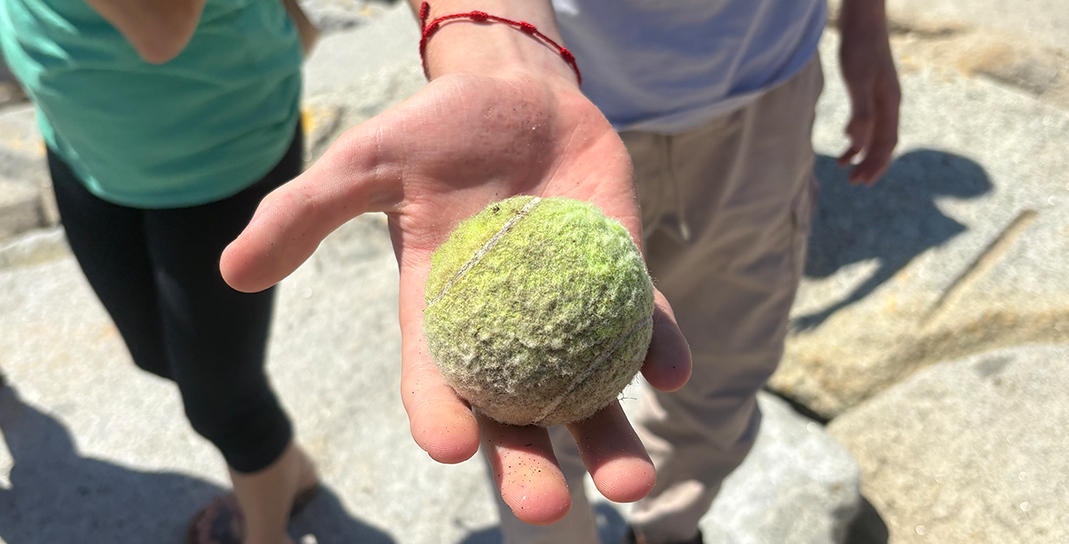
Many of the balls found have spent years exposed to sun, salt, and wave erosion. Iridescent, cracked, polished, and transformed by time, they develop what the artists describe as a kind of “devenir roca”: they camouflage themselves among the blocks of the breakwaters to the point of blending into their surroundings. Recognising them requires a patient gaze, capable of reading the material transformations of the coastline and understanding the shore not as a fixed stage, but as a space traversed by ecological, economic, and social processes.
On May 21st, we shared the first experience with the Institut Escola Lluís Millet in El Masnou, together with 3rd-year secondary school students and their teachers. The day began with a brief presentation of the project, which contextualised the artists’ work and explained the main lines of their research. We then headed to the nearby breakwaters, in the area of Port Esportiu of El Masnou.
Very soon, the first findings appeared, and within a short time the group had located around a dozen balls. The students were especially active and engaged, showing the enthusiasm of those discovering a new way of looking at a familiar place. Among the rocks, other unexpected remains also emerged, such as a car wheel rim trapped between the blocks, an object as surprising as it was revealing of the multiple layers of history accumulated along the coast.
A few days later, on Saturday May 23rd, the second outing took place, this time with a group made up of members of the Chiquita Room community and others connected to the project. We met near the Port of Barcelona. We were around eight people of different ages, united by the same curiosity and the desire to locate these balls trapped among the rocks.
In this case, the terrain presented additional difficulty. The breakwaters were much larger, and access to the objects considerably more complex. It was then that Linda Sanchez and Baptiste Croze put into practice the experience they have acquired over years of field research. With a combination of patience, observation, and improvisation, they demonstrated different strategies for reaching the most inaccessible areas: from skilfully moving between the rocks to building small improvised tools to retrieve the trapped balls without disturbing the environment.
These walks have shown how artistic research can become a tool for mediation and for the production of collective knowledge. By transforming walking into methodology and curiosity into a form of investigation, the project reminds us that the landscape is a living archive, full of traces, memories, and often invisible relations.
The balls recovered during these days in Catalonia now become part of the ongoing research by Linda Sanchez and Baptiste Croze, expanding their collection. Each new finding adds a singular trajectory, a story still partially unknown, contributing to this ever-growing collective cartography. Today, the collection includes around 500 balls recovered from different points along the Mediterranean coast, and it continues to grow with each new expedition.
We would like to conclude this account with our sincere gratitude to the artists for their generosity and for the open way in which they share their working processes. Teenagers, teachers, volunteers, visitors, or simply curious individuals become, for a few hours, active observers of a phenomenon that connects ecology, geography, material history, and collective experience.
Projects such as Roulé-boulé remind us of the capacity of artistic practice to generate knowledge, build community, and activate new forms of relationship with the environment. Supporting these kinds of practices means embracing ways of thinking about territory through complexity and sensitivity. It also means defending spaces where art helps us understand the world, inhabit it, and imagine it differently.
Thanks to Linda Sanchez and Baptiste Croze for inviting us to follow the traces of these Mediterranean constellations. Until the next exploration.
